 CitrusNest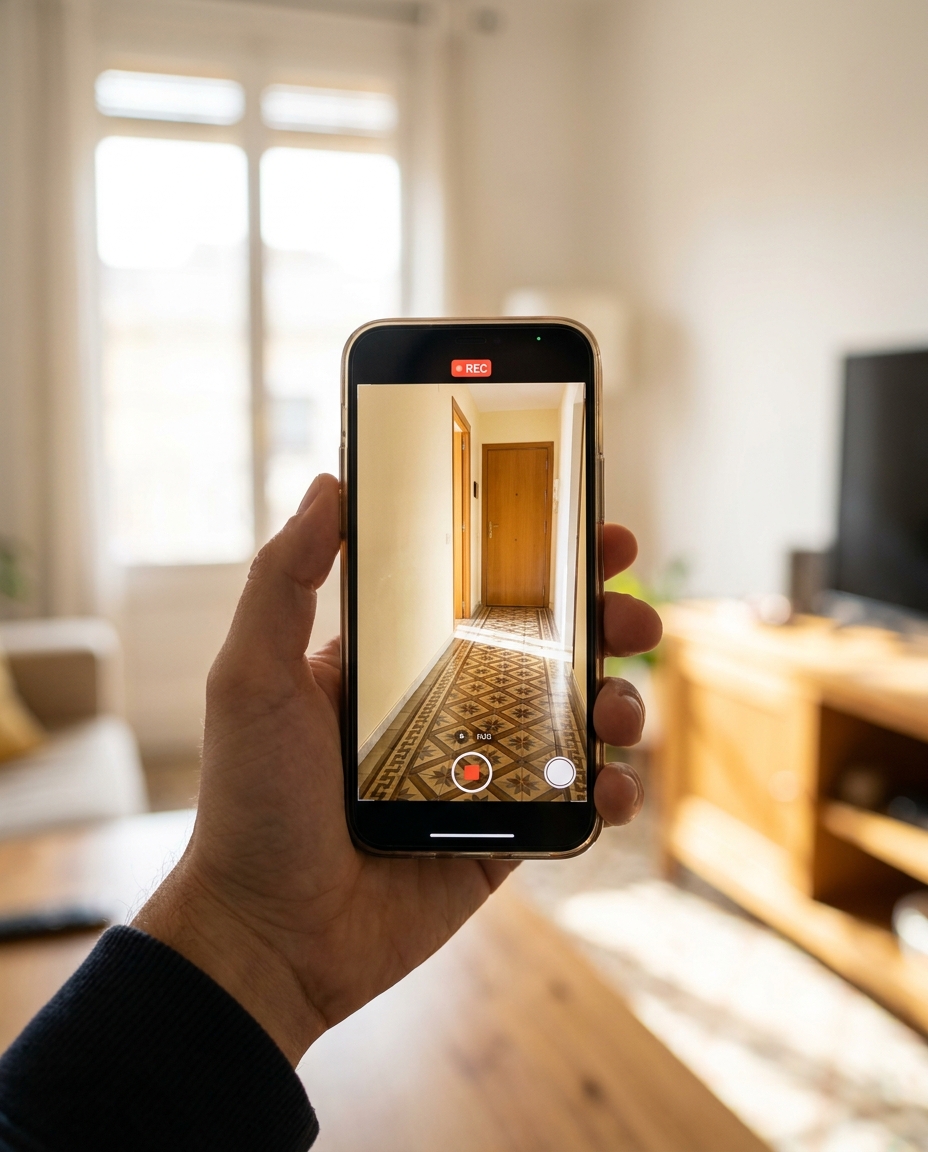
The short answer
Fresh paint can cover a mark. It does not show that the source of water was identified, repaired, or that the area stayed dry. A stain is a clue, not a diagnosis. Ask for records and, when the condition matters to your purchase, leave room for an independent qualified professional to assess it.
A mark is a clue, not a diagnosis
In an apartment viewing, a brown corner, bubbling paint near a ceiling, or a line above a baseboard is worth noticing. It does not establish what caused it.
Depending on the property, a qualified professional may need to distinguish among plumbing, rain entering through a roof or façade, failed sealing around a window or terrace, condensation on a cold surface, or moisture entering a lower wall. Those possibilities do not share one repair. Some may be contained inside the apartment; others may involve a roof, exterior wall, terrace, or shared pipework. Some may only show themselves in particular weather.
A quick viewing cannot settle the cause. The useful answer is not “it only needs paint,” but “this is what caused it, this is what was repaired, and this is the evidence.”
Why “it only needs paint” should slow you down
An explanation offered during a viewing is an account to verify, not a building diagnosis. That is not an accusation of deception. It is simply not enough information about the water.
Fresh paint can make a wall look clean for photographs and viewings. The relevant general principle is straightforward: paint is a finish, not an investigation. The U.S. Environmental Protection Agency says that moisture control is key to mold control, that the water problem must be fixed, and that paint over moldy surfaces is likely to peel.
Ask for a paper trail
Do not argue about whether the wall “just needs paint.” Ask questions that can be answered with records.
- What was the source of the water?
“Humidity” (humidade) is not a complete answer. Was it a roof leak, plumbing, rain penetration, condensation, a terrace, a neighboring unit, or something else?
- Is the source repaired?
Ask who carried out the work and on what date. “It happened years ago” is a claim, not proof.
- Can the seller show invoices, reports, photographs, or a warranty?
Before-and-after photographs can be useful when the repair is now concealed.
- Has the area stayed dry since the repair?
Ask how that was checked. If rain penetration is suspected, try to view after rain. If plumbing was involved, ask how the repaired system was tested. A dry-looking wall during one viewing does not establish how it behaves over time.
- Was the area assessed after the repair?
Ask whether an independent qualified professional checked it, what method was used, and how the result was interpreted.
- Could the suspected source involve another part of the building?
If it may involve the roof, façade, terrace, or shared services, ask what approvals, access, and payment may be required. Have your lawyer and technical adviser check the relevant responsibility rather than assuming the answer.
- What do the condominium records say?
Ask your lawyer to review relevant meeting minutes, planned works, disputes, insurance claims, and budgets for recurring water problems.
What to observe during the viewing
You are not trying to become a damp specialist in an afternoon. You are deciding whether the property deserves a proper inspection.
- Paint that is newer than the surrounding wall, especially in isolated patches.
- Bubbling, blistering, flaking, or powdery paint.
- Staining at ceilings, exterior corners, window edges, and baseboards.
- Swelling in timber, laminate, or cabinetry.
- A musty smell, including inside cupboards and behind furniture.
- Dark spotting or salt-like deposits on walls.
- A dehumidifier running during the viewing; ask what it is intended to address.
- Similar marks in the common stairwell or on the exterior of the building.
None of these observations proves a particular defect. Together, they tell you where to ask harder questions.
Buying remotely? Request this video pass.
Ask for a continuous video from outside the building into the affected room. Then request close-ups of the mark, the wall above and below it, the corresponding exterior area, and any room or terrace on the other side where access is possible.
“Please record one continuous pass from outside the building to the affected room, then show the marked area close up, the wall above and below it, the corresponding exterior area, and the room or terrace on the other side where possible.”
Use it alongside our remote viewing checklist. Listing photographs are made to show an apartment at its best. Your job is to understand what still needs explaining.
The acceptable version of “we painted it”
Painting is not suspicious by itself. Repainting after a real repair is normal. A more reassuring answer is specific, documented, and open to independent inspection:
“A pipe above the ceiling leaked in February. A plumber replaced the failed section and tested it. Here are the invoice and photographs. The area was dried, checked again, and repainted in April. You are welcome to have it inspected independently.”
That account can be checked. “It only needs paint” cannot.
Our verdict
A visible moisture mark does not automatically make a Portuguese property a bad purchase. It is a reason to pause and investigate, not a diagnosis by itself.
Worth a look
The source and repair are described and supported by records, the seller can show how the area was checked afterward, and the seller welcomes an independent inspection.
Worth it at a lower price
A suitably qualified independent professional identifies a repairable issue, but you would be taking on documented work, disruption, and uncertainty. Clarify the scope and responsibility with the relevant advisers before deciding whether the price accounts for it.
Walk away
The seller will not permit a reasonable inspection, the explanation keeps changing, or the purchase only works if you assume the cheapest possible cause.
The rule is simple: do not pay for the repaired version of a home when all you have seen is the repainted version.
Source note
U.S. Environmental Protection Agency, “A Brief Guide to Mold, Moisture and Your Home” (source page updated February 18, 2026). The guide says moisture control is key to mold control, the water problem must be fixed, and paint over moldy surfaces is likely to peel. It is cited here as general guidance, not as Portugal-specific law or a technical standard.