 CitrusNest
The short answer
Ask for a useful video, not a prettier listing.
Ask for one continuous video that starts on the approach to the building, moves through the shared spaces and every principal room, and ends only after the details and records you need have been shown. Have windows, cupboards and storage opened, and ask to see visible condition clues close-up instead of accepting a quick explanation. Use the tour to decide whether a home earns an in-person viewing or an independent inspection—not as proof that the property is sound.
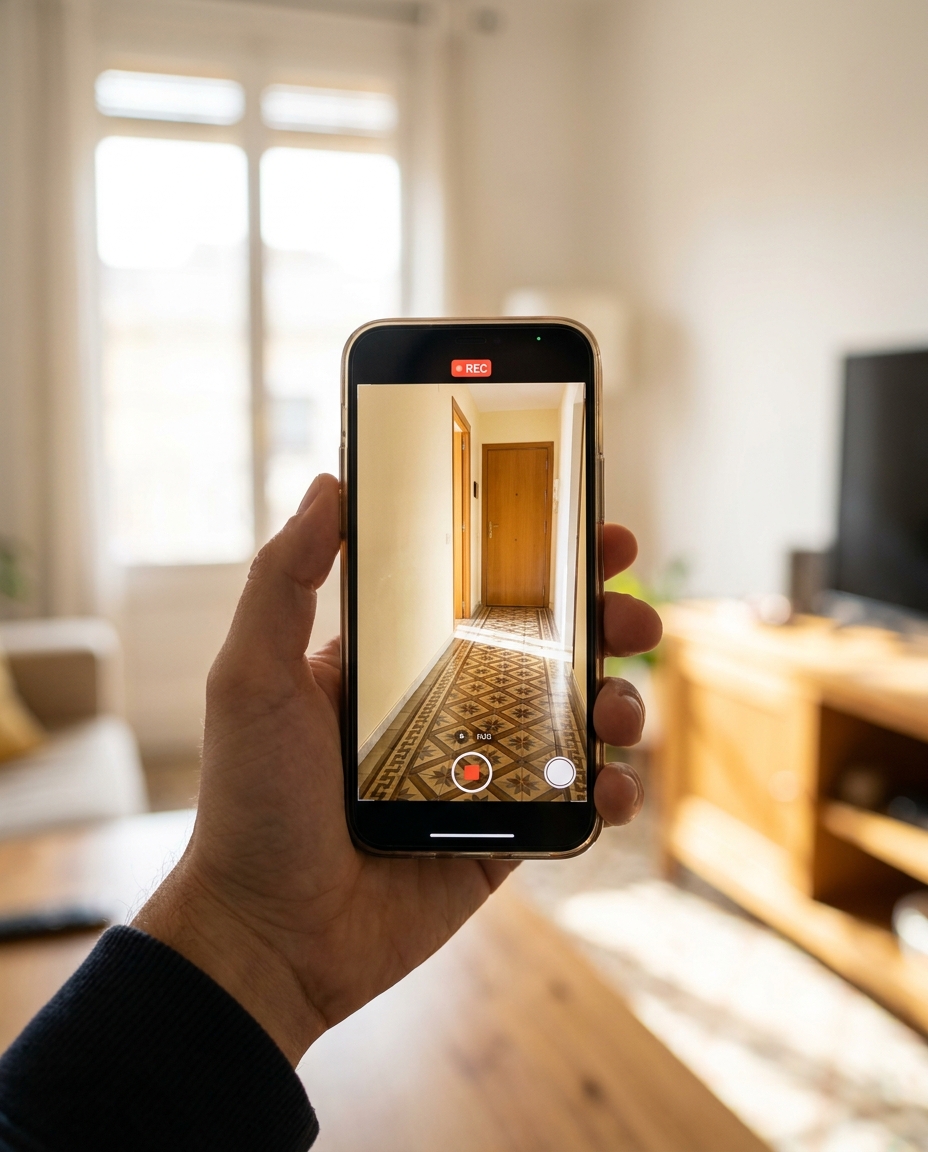
Keep this beside the call
Remote viewing, at a glance
You do not need to inspect everything through a phone. You do need a tour that leaves fewer important blanks.
- Start on the route and show the exterior before entering.
- Film the entrance, common areas, stairs and any lift.
- Walk every principal room in one continuous pass.
- Open windows and pause to hear what is audible.
- Show daylight, outlook and orientation as observed that day.
- Open cupboards, wardrobes and any promised storage.
- Show visible clues without asking anyone to diagnose them.
- Finish with utility, document and close-up follow-up requests.
The order matters
The shot and request sequence
Send this order before the call. It helps the person filming prepare, and it makes omissions easier to notice afterward.
-
Route and exterior
Request: Start at a useful arrival point you have chosen—a nearby transit stop, practical drop-off or the street itself—and walk to the entrance without cutting. Show the pavement, slope, street-facing façade and doorway. This is context for your priorities, not a claim about the neighborhood.
-
Common areas, stairs and lift
Request: Film the building entrance, hall, stairs from the ground level to the apartment floor, and the lift if there is one. If there is no lift, show that plainly. Shared spaces are part of what you are buying into, not dead time between the street and the apartment.
-
One continuous pass through the rooms
Request: Begin at the apartment door and move through every principal room in a natural order, including kitchen, bathrooms, balconies and terraces where present. Keep the camera moving slowly enough to understand proportions, doors and circulation. Edited clips can answer a detail; they cannot show how the home fits together.
-
Windows open, then listen
Request: Open the windows in the living room and bedrooms, point the camera outward and pause. If street, train, bar or construction noise is audible, let it be audible. Ask what time the video was filmed, because a single recording is only one moment.
-
Light and orientation as observable context
Request: Pan from each main room to its windows and exterior outlook, and note the time and weather. If the orientation is known from a plan or listing, ask for that source as well. A video can show the light that day; it cannot promise the light at every hour or in another season.
-
Storage, cupboards and working space
Request: Open built-in wardrobes, kitchen cupboards and any storage advertised with the apartment. Include cellar, attic, garage or exterior storage where relevant. A wide-angle room shot does not show what actually fits behind a door.
-
Visible condition clues, without a diagnosis
Request: Slow down for changes in paint, bubbling or flaking finishes, staining, swelling in timber or cabinetry, marks around windows and skirting boards, and anything similar in the shared areas. Ask for a close-up and the surrounding surface. These clues do not prove a cause; they tell you where to ask better questions. For that next step, read Fresh Paint Is Not a Damp Repair.
-
Visible utilities and document prompts
Request: Show what is visible: the electrical panel, water heater or boiler, radiators or cooling equipment, and any meter or control that can be accessed. Seeing equipment is not a test of its condition or operation. Ask which current records are available, including the energy certificate and relevant condominium meeting minutes, then have your own lawyer and qualified technical adviser review the documents that matter to your purchase.
-
Close-ups and follow-up
Request: End by returning to every blurred, omitted or concerning detail. For a mark on a wall, ask to see the wall above and below it, the corresponding exterior area, and any room or terrace on the other side. List what still needs a live follow-up, an in-person viewing or an independent inspection before you move forward.
Ask before the camera starts
Questions to ask before relying on a video
- Can the person filming follow this sequence in one continuous pass? If the answer is no, ask which parts must be separate and why.
- Who will be on the call, and can they answer questions as they film? A person who can only read a listing description may not be able to resolve what you are seeing.
- When was the footage taken, and what were the weather and time conditions? That gives the light and sound some context without turning one moment into a general conclusion.
- Which spaces or exterior areas cannot be shown? Ask about any omitted room, storage area, terrace, common space or building feature before treating it as unimportant.
- Which answers can be supported with a current record? Keep explanations, documents and follow-up requests separate. A confident answer is still an answer to verify.
Keep the boundary clear
What a remote viewing cannot tell you
Video is useful evidence. It is not a survey, a document review or an inspection of hidden systems.
Behind finishes
A camera cannot inspect what is inside a wall, under a floor or behind a fitted unit. Visible clues are prompts for a qualified professional, not conclusions.
Across time
Light, sound and building activity can change by hour, day and weather. One recording gives you one useful observation, not the full pattern.
Whether a system works
Showing a panel, appliance or lift is not the same as testing it. Do not substitute a video for independent checks that the purchase needs.
The decision
Use the video to decide what the home earns next.
Move forward only when the route, building, rooms and relevant records can be shown coherently, and the remaining unknowns are clear enough to check independently. Do not price a property as though an omitted detail has the answer you want.
Worth a closer look
The full pass is possible, the important questions receive specific answers, and the gaps are reasonable candidates for an in-person visit or independent inspection.
Pause and investigate
A detail is visible but unexplained, a document is missing, or the route, noise, storage or common areas were skipped. Keep the issue open rather than guessing.
Walk away
Do not proceed on faith if a reasonable tour, supporting record or independent inspection is refused. The video has done its job: it has shown you the limit.
Methodology & source note
This is CitrusNest’s viewing method.
It is a repeatable order for our property walkthroughs and buyer explainers: route first, building second, rooms in one pass, then the details that need a closer question. The visible-condition requests draw on Fresh Paint Is Not a Damp Repair: a mark is a clue, not a diagnosis. This guide is general buyer education, not a property survey, diagnosis or legal advice. Read how CitrusNest works before relying on any guide as a substitute for your own independent checks.